

Assistant professor of electrical and computer engineering named IEEE Alabama Section Young Engineer of the Year
Published: Dec 16, 2025 2:00 PM
By Joe McAdory
Hunter Burch is turning lightning strikes, space weather and invisible physics in the ionosphere into tools that protect satellites, aviation and the nation’s power grid. It’s no wonder the assistant professor in the Department of Electrical and Computer Engineering was named the Institute of Electrical and Electronics Engineers Alabama Section Young Engineer of the Year.
Burch, who received the department’s junior-level Research Award of Excellence this past September, leads fundamental and applied programs in ionospheric sensing and defense-focused electromagnetics and was recognized at the section’s annual banquet Wednesday, Dec. 10, in Birmingham.
“This award confirms that we’re doing the right things the right way,” he said. “When you start out as an early career faculty, so much can get thrown at you. It is nice to have that recognition that shows we’re doing useful research that makes a positive impact.”
Through the Applied Radio Science Laboratory, Burch’s group is developing low-cost, ground-based sensors to remotely sense the near-Earth space environment.
Much of the group’s work centers on developing low-cost, ground-based passive sensors that can remotely sense the near-Earth space environment. Unlike traditional sensing methods that rely on satellites, radars or other expensive infrastructure, these passive systems use naturally occurring signals, including lightning, to characterize conditions in the ionosphere.
Burch said these measurements are increasingly critical as society becomes more dependent on satellite navigation, aviation operations and power grid stability, all of which can be disrupted by space weather events.
“Hunter is tackling some of the most fascinating and challenging problems in applied electromagnetics and space weather,” said ECE Chair Mark Nelms. “His work is helping us better understand the environment above Earth and its impact on the systems we rely on every day. This IEEE award is a well-deserved recognition of the quality and promise of his research.”
Since joining the Auburn faculty in 2022, Burch has secured more than $1 million in research contracts and co-founded the college’s Summer Undergraduate Research Experience, strengthening graduate student enrollment while mentoring dozens of emerging researchers.
Although he works at the frontiers of electromagnetic sensing and space weather research, Burch said the driving force behind his work has always been people.
“The reason we do it is not because of the outcomes of the research product,” he said. “The reason we do it is the development of the young engineers who are working on all this cool stuff.”
His lab includes roughly 15 students — six full-time doctoral students, numerous undergraduates and even a former undergraduate whom Burch recently hired as a full-time research engineer.
“I just met with a guy today who’s a freshman who came and said, ‘I don’t understand anything you guys do, but I want to. Can I get involved?’ We’re going to bring him in and get him involved,” said Burch, also the department’s graduate program co-officer. “That’s what keeps me coming in here every day — the opportunity to develop students.”
Media Contact: , jem0040@auburn.edu, 334.844.3447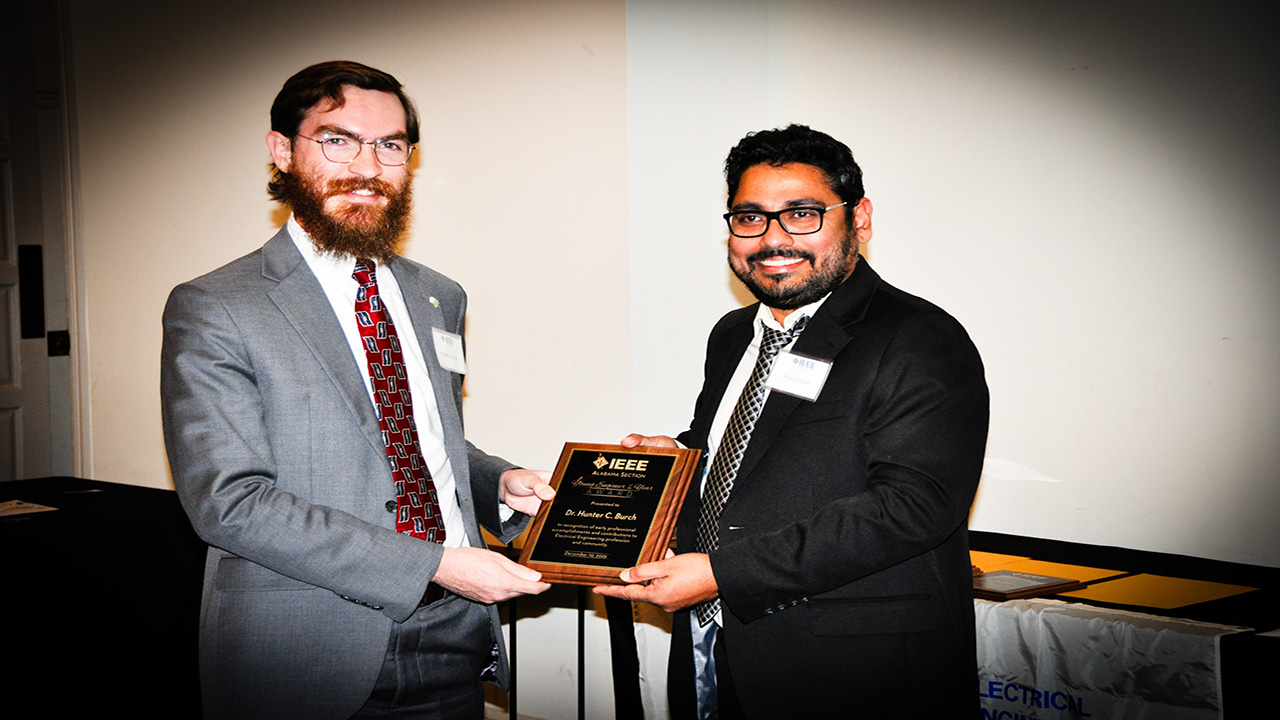
Hunter Burch, left, with Alabama IEEE Section Chair Arup Ghosh.
