James E. Livingston began his journey as an Auburn guy — that’s what he calls himself — in 1959. Though the University of North Georgia, where he spent his freshman year, offered a lot, it didn’t offer engineering. That’s what he really wanted to do. It’s what growing up on a family farm in Telfair County, Georgia — working hard from dawn to dusk and then some, in the classroom, in the fields, solving the problems that come with tending tobacco, cotton, sugarcane and most every other crop the South Georgia soil could produce — taught him he might be good at.
Civil engineering seemed like a good fit. Georgia Tech was an obvious choice. It was in-state, a fine school — just not as, say, diverse as a red-blooded, aspiring engineer might want. What Tech may have had in smarts, it lacked in scenery. He wanted something more, and Auburn, upon inspection, had an abundance.
The decision was easy. The first year was not. Studying engineering at Auburn, as it turned out, wasn’t a cakewalk.
While living at the Sigma Pi house was great for camaraderie, it had drawbacks come exam time, enough to eventually draw comment from back home: Pick up the slide rule or hop back on the tractor. He went with the slide rule. He moved out of the fraternity house and began practically living at Broun Hall. He read the Auburn Creed and put it into practice. He entered ROTC. The discipline he was raised on returned, and it refined him. He hit the books. He did the job.
Three years later, in 1962, it was mission accomplished. Livingston hung the diploma and pointed to it proudly. He was an Auburn graduate — an Auburn civil engineering graduate. That meant something. That’s the way it usually goes, of course. People cross the stage, then bask in the fact that they had what it took — that they did it and did it at a place like Auburn. They chase that feeling across their careers and for the rest of their lives — in their résumés, with their lapel pins, in the frame on their wall. Livingston was no exception.
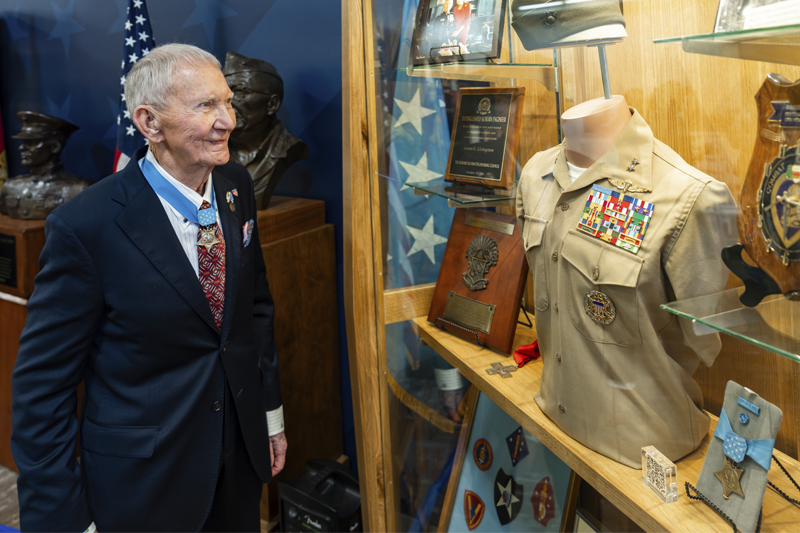
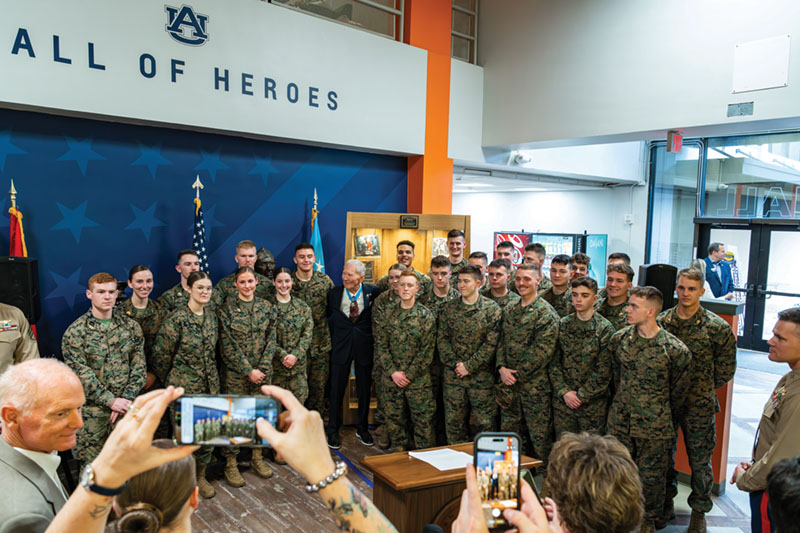
But it was only on the morning of Feb. 27, 2026, at the dedication of the James E. Livingston section of Auburn’s new Wall of Heroes in Foy Hall, that he truly realized his association with the place was now a little different. Because the desire to maintain it? It was reciprocal — as much as it can be between an alumnus and his alma mater. That realization, he said, was hard to put into words. He’d always made room for Auburn on his wall. Now a wall at Auburn had room for him. And to think that it was a wall in Foy Hall… the old student union, the building that Medal of Honor recipient Maj. Gen. James E. Livingston, Auburn Guy, was in when he decided 65 years ago to become a Marine, one of the best there ever was.
The click
That he was in charge of Echo Company seems fitting. That sound — that echo — just before things changed is the one thing he and his men remember. Every book on the battle, every documentary, every oral history includes recollections of the gruesome, collective click following the order of then-Capt. James E. Livingston.
“To have 180 bayonets click at one time is a pretty gruesome sound,” Livingston said. “But I told them: Fix bayonets, we’re going for it.”
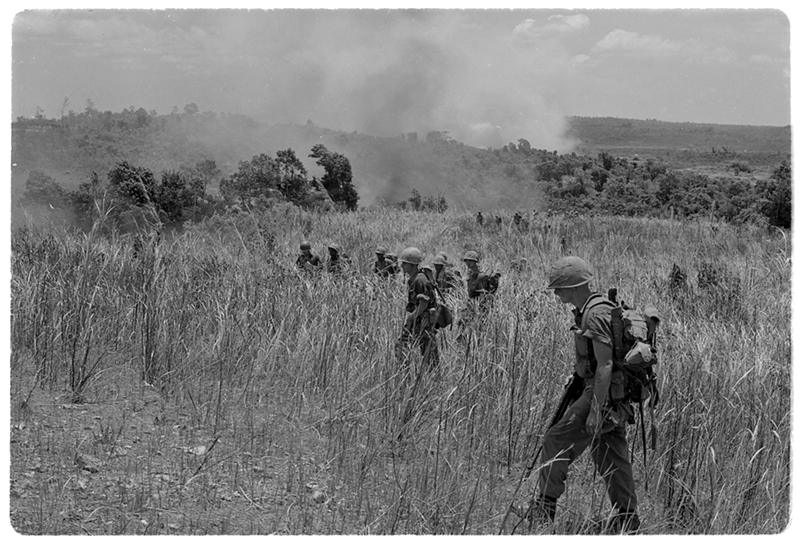
It was a May 2, 1968, assault to support Golf Company, pinned down near a tiny dot on the map in the Cua Viet River Valley — Dai Do. The North Vietnamese Army (NVA) had turned the village into a complex of more than 100 bunkers as part of a planned offensive to seize a vital American supply base. The 600 men of the 2nd Battalion, 4th Marines, were ordered to stop them.
Two months earlier, Livingston successfully led Echo Company in a similar rescue mission at Vinh Quan Thuong. This, he knew, would be different. The big leagues. Hell on earth. Final exam time. Bayonet time.
He also knew Echo was ready for it. When he took command nine months earlier, they weren’t.
The 2nd Battalion was tough. And they had a reputation, a nickname even: the Magnificent Bastards.
But Echo had loosened up. Discipline was down. Morale was down. Livingston, a year into his second tour of Vietnam, brought it back up — quickly. The Auburn guy had his own reputation: calm under pressure, but as gung ho as they came. Commissioned as a second lieutenant after graduation, he served as a platoon commander, intelligence officer and series commander training recruits at Parris Island. After being promoted to captain in June 1966, he served as commanding officer of the Marine detachment aboard the aircraft carrier USS Wasp. Under Livingston, you didn’t flop down after a patrol. You took care of yourself and your equipment. You cultivated a sound body and a sound mind.
“I would not put up with (slacking),” he said. “Intensity saves lives and preparation saves lives. I had time to do the things I needed to do to process the issues with the company. I was able to come up with a game plan to do the things I thought I needed to do to make them a better company that’s ready to fight.”
And fight, they did. The five football fields of rice paddies Livingston ordered them across at 5 a.m. were already red. Another company had tried the same charge the day before. They’d failed. Bodies were still everywhere; one was the company’s commander. More would be added.
“I had 16 or 17 killed right there as we began to try to crack through this complex of bunkers,” Livingston said.
The strategy was fire and maneuver. Keep moving. Close the distance. Livingston darted back and forth between the points of heaviest resistance. To truly lead, he said, “you’ve got to smell the gunsmoke.”
“I was between the two front platoons, but the reserve platoon behind me got bogged down,” Livingston said. “So I moved my command post into the reserve platoon. And we finally penetrated the village of Dai Do.”
The bayonets were needed.
Livingston knew that long-range firefights favored the entrenched NVA. At the time, the command — the click — was almost more psychological than anything. In terms of actual tactics, bayonet charges were more WWII than Vietnam.
“But I needed something to let them know it was the real deal,” Livingston said.
It wound up more real than he expected, and the bayonets more crucial. They worked as motivational tools.
They worked in other ways, too.
“They were fighting for their lives; we were fighting for ours,” Livingston said. “It was close-in killing,” he said, pausing before saying it again. “It was close-in killing.”
It lasted three hours. Clearing bunkers with grenades. Clearing them hand-to-bloody-hand. By the end, only 35 of his 180 men could still stand. Eighteen were dead, the rest wounded. Livingston had taken grenade shrapnel.
But the Magnificent Bastards had taken Dai Do. They’d done the job. Then Livingston gave them another one, lack of orders be damned.
“The battalion commander directed another company to come around our left flank and begin the attack further north,” Livingston said. “They got surrounded. There were only 70 of them, commanded by a young second lieutenant. He kept asking, ‘Where’s Echo, where’s Echo?’ He thought he was going to have Echo as part of it.”
Livingston, trying to recuperate, had thought the same. He waited for orders. The call from leadership never came. The call of duty did.
“I finally just said, ‘The hell with it,’” he said. “I told my 35 Marines, ‘we’re going to go help Hotel Company.’”
It was more of the same. Hell broke loose again, for hours. And Livingston broke loose again, the gunsmoke still in his nostrils, thicker than ever. He was everywhere.
Then the NVA turned an antiaircraft gun on Livingston’s position. He was shot. His radio operator was killed. He was shot again. He was down. He wasn’t out.
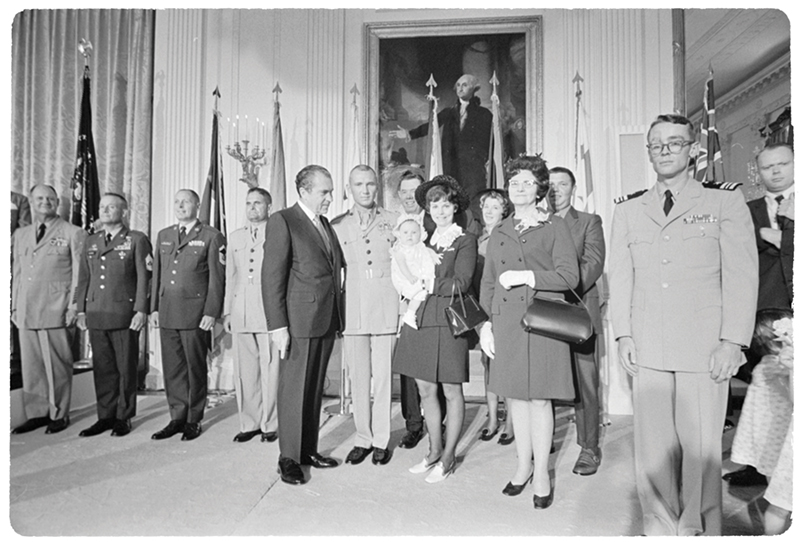
Here is how President Richard Nixon, reading from a document bearing the United States seal, described the scene two years later:
“Wounded a third time and unable to walk, Livingston steadfastly remained in a dangerously exposed area, deploying his men to more tenable positions and supervising the evacuation of casualties. Only when assured of the safety of his men did he allow himself to be evacuated.”
Honor on display
At the time, no one knew the exact number — just that it was obviously like David versus Goliath. Eventually it came out that the 600 Magnificent Bastards of the 2nd Battalion, 4th Marines had stared down and ultimately routed an NVA division numbering more than 10,000.
In terms of raw odds, historians deem the Battle of Dai Do the most lopsided of the entire Vietnam War. It was brutal. But it was won, in no small part, through the discipline, devotion and courage of a Marine captain from south Georgia — an Auburn guy who won the respect and confidence of his men through a spirit that never seemed close to afraid, and who earned the Medal of Honor in the process.
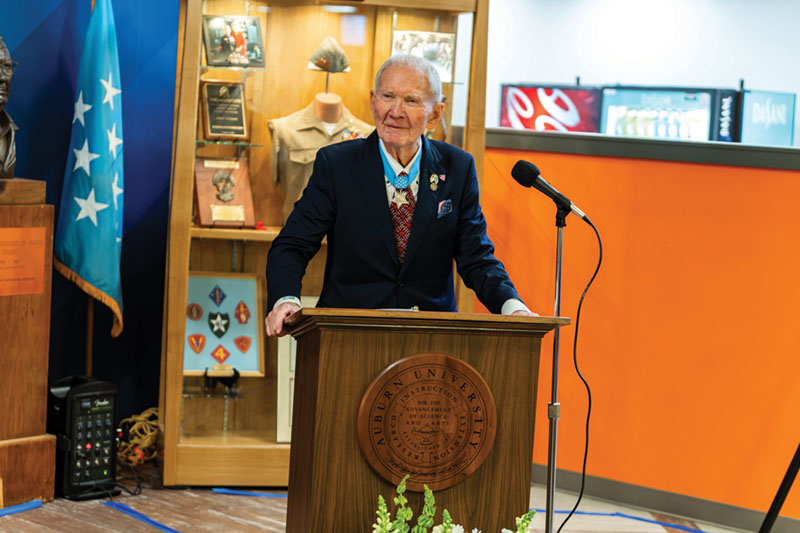
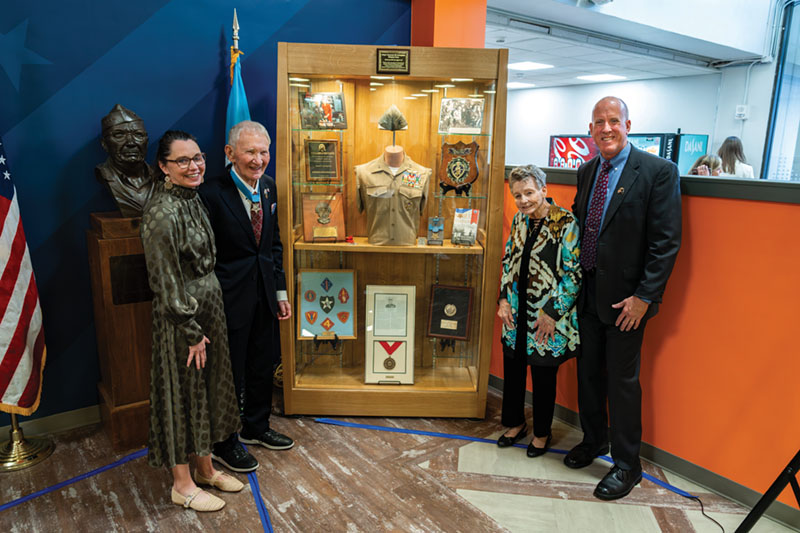
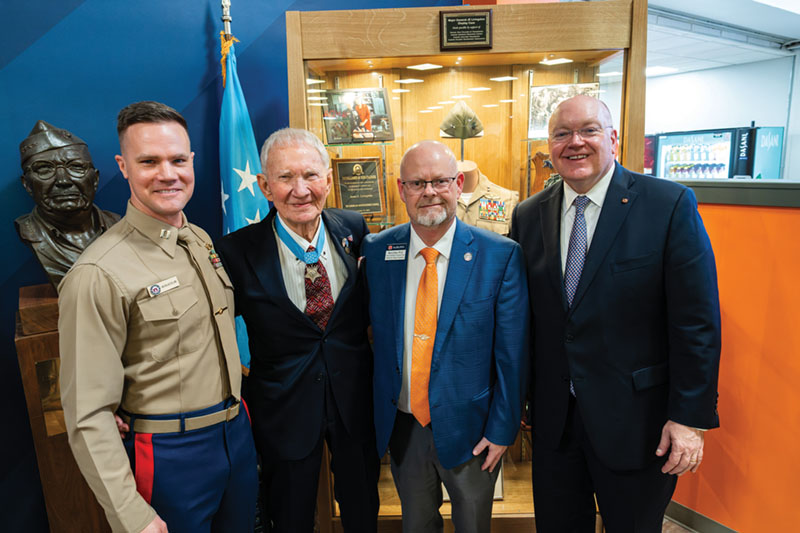
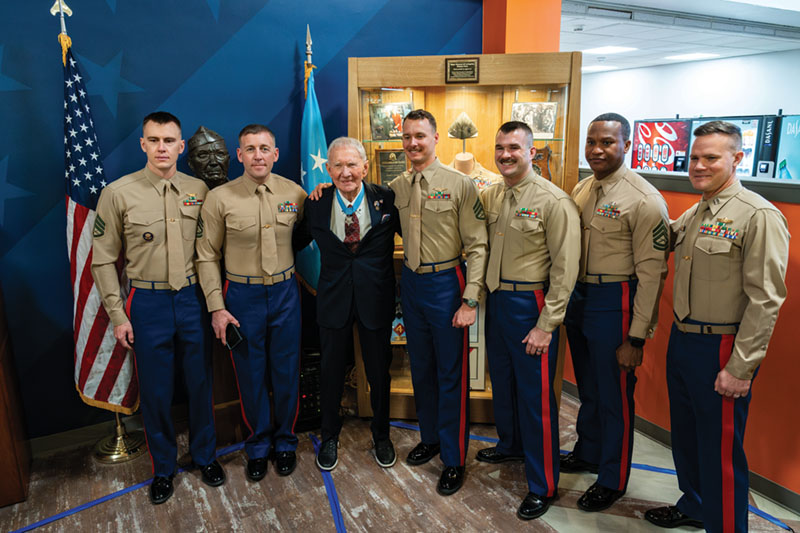
Livingston stepped to the lectern. He was happy to be back in Auburn, he said — even back in Foy Hall. That’s where he used to like to hang out, he joked — where the ladies used to be. Livingston met his wife, Sarah, while stationed at Parris Island. They have two daughters and three grandchildren. All were there for the unveiling, along with military and university officials, including President Chris Roberts and Mario Eden, dean of engineering — all there to speak about him.
The cover came off. People applauded. It’s a wonderful display. It tells a story. Livingston’s uniform is there, along with his patches. A copy of the 2010 book on his life, Noble Warrior, documents not just the Battle of Dai Do but the heroics behind his other medals — the Navy Distinguished Service Medal, Silver Star, Defense Superior Service Medal, Bronze Star Medal with Combat “V” and three Purple Hearts.
There’s also his Distinguished Auburn Engineer plaque, as well as his Lifetime Achievement Award, displayed beside the medal from his 2025 induction into the State of Alabama Engineering Hall of Fame.
But the crown jewel is the solid bronze, five-pointed star at the center — the medal with the light blue ribbon spangled with 13 white stars, the one awarded by Congress. The one he chose to donate to the institution he believes, in no small part, helped him earn it.
“Part of the Auburn Creed stresses earning what you receive through hard work,” Livingston told the crowd. “The Marines put that to the test, but Auburn built my character and the Marines sharpened it to a fine edge. “Auburn taught me the value of teamwork and how to accomplish and overcome difficult objectives. These lessons would later manifest in very real life and death situations in Vietnam.”
In some small way, he said, he hopes the display might help instill those same lessons in the next generation of Auburn men and women.
“I hope it might embolden them to be stronger students, to want to study and really excel in whatever they do,” Livingston said. “If we can share that opportunity and talk about those experiences, I hope they empower other kids who might look at that display and say, ‘he was an Auburn guy.’”

