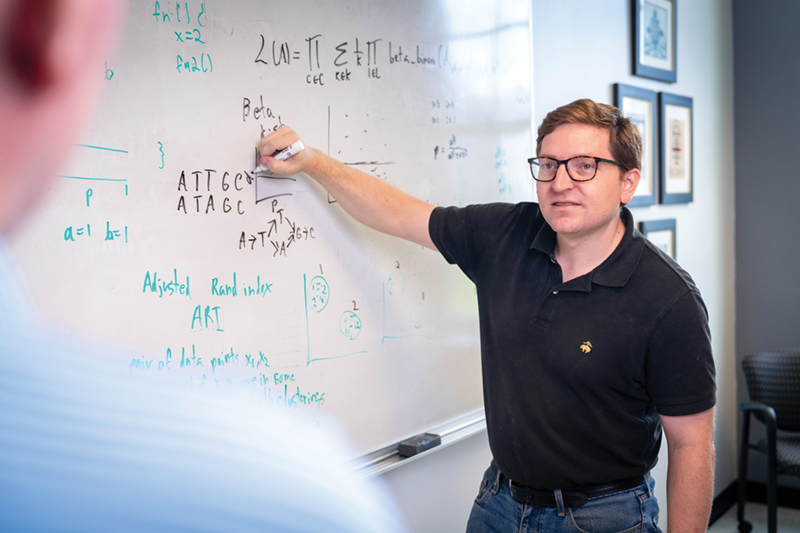
Haynes Heaton, an assistant professor in the Department of Computer Science and Software Engineering, has developed software likely to change the standard of care for leukemia patients undergoing bone marrow transplants.
Dr. Heaton, a computer scientist, computational biologist and medical doctor, and collaborators at the Fred Hutchinson Cancer Center at the University of Washington were awarded a $3.5 million grant from the National Institutes of Health for their project, “A Compass for Those With Relapsed Leukemia After Transplants.”
By using his software, “Cellector,” Dr. Heaton and fellow researchers hope to replace current diagnostics for post-bone marrow transplant relapse monitoring with single-cell RNA sequencing.
Cellector makes statistical distributions from thousands of data points.
Using a beta-binomial iterative anomaly detection system, Cellector accurately distinguishes donor bone marrow cells from user bone marrow cells among transplant recipients to within .05%.
“This is important because if a patient’s blood is being generated from his or her own bone marrow — their own genotype — then that person very well might be having a leukemia relapse, which is highly deadly,” Heaton said.
Heaton’s latest research project allows him to combine his disciplines and develop a computational diagnostic tool capable of saving lives.
“The basic research that I do is empowering other people to do better research that is tied to DNA sequencing, and we will have health impacts down the line,” he said.

