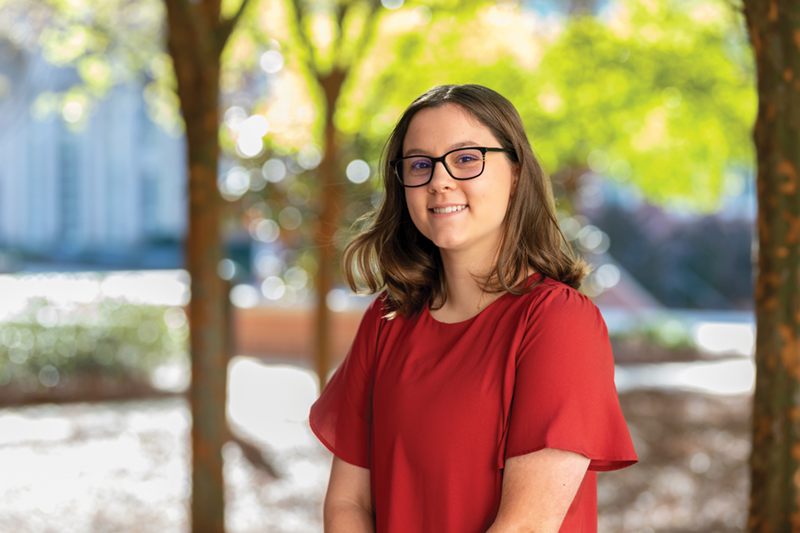
Katie Wolfe ’24
Electrical Engineering and Theatrical Design
Walt Disney Imagineer/Ride Controls
Why Auburn? What led you to such a unique double major?
I chose Auburn because it was the only school where I felt like I didn’t have to pick just one path. I’ve been drawn to engineering since I was a kid taking apart my dad’s toaster, but as I got older, I started to fall in love with the arts, too.
Auburn gave me the space to explore both seriously. Majoring in electrical engineering made sense because I’ve always loved problem-solving and building things, but I didn’t want to lose the storytelling side of what I enjoyed.
That’s what led me to double major in electrical engineering and theatrical design. Entertainment engineering, in particular, sits right at the intersection of both my passions. It’s technical, but it’s also emotional and narrative-driven. Auburn didn’t just “put up with” my two majors — it supported me class-by-class and through every scheduling conflict.
What do you do for Disney?
I work in ride engineering, where I get to contribute to the control systems that help bring attractions to life.
Day-to-day, that can involve coordinating between different disciplines, selecting hardware components, thinking through how systems interact and helping ensure everything comes together in a way that’s both functional and aligned with the creative vision.
What attracted you to working for Disney?
What attracted me to Walt Disney Imagineering is the level of intentionality behind every detail. I started as an intern, and I actually applied for that internship after riding Cosmic Rewind at Walt Disney World for the first time. My sister and I got off the ride and started talking about how fun it must be to design attractions, and now I’m here. For me, it boils down to the fact that at Walt Disney Imagineering, I get to design stories. Growing up, I was fascinated by the way theme parks made me feel, and now I get to be part of the team that creates that experience for other people.
What is it like combining the work of engineering with entertainment?
Getting to combine the arts and engineering is one of the most rewarding parts of what I do. Engineering gives you the tools to make something that works reliably and safely, while the arts make people feel something while they’re there. When you combine the two, you’re creating experiences that are both technically precise and emotionally impactful. That’s themed entertainment.
In themed entertainment and live experiences, you’re constantly balancing those two “opposites.”
You have to design a system that functions flawlessly for hundreds of thousands of guests, but it also has to disappear into the story. My goal for everything I design is for no one to ever think about it. I want them to just feel the result. That mix of feeling and technology is what makes the work so exciting.
How did Auburn Engineering prepare you for this work?
Auburn Engineering gave me a really strong technical foundation, but just as important, it taught me how to think through my designs with care and intention. A lot of the work I do now involves solving problems that don’t have a clear answer, working across multiple different disciplines and adapting quickly when things change.
Through the coursework, labs and projects I did at Auburn, I learned how to break down complex problems, communicate my ideas clearly and collaborate across a team. Auburn taught me how to move between detailed engineering work and big-picture thinking, which has been incredibly valuable for me in themed entertainment.
What advice would you give to students and young alumni who are considering careers in fields that might seem unconventional to engineers?
Don’t feel like you have to fit into some predefined version of what an engineer is supposed to be. Some of the most interesting and impactful work happens at the intersections between different fields and disciplines.
If you’re interested in something unconventional, lean into it. Build skills in all areas, not just engineering, and look for ways to connect them. Most importantly, don’t be afraid to create your own path if one doesn’t already exist. Once you learn how to communicate what you want to do in a way that makes sense to people outside your field, doors start to open.
There’s a lot more room in engineering than people realize, and a unique combination of interests can end up being your biggest strength.

